

Global Product Engineering Services Market Size to Reach USD 1972.39 Billion by 2032: Maximize Market Research
Product Engineering Services Market graph
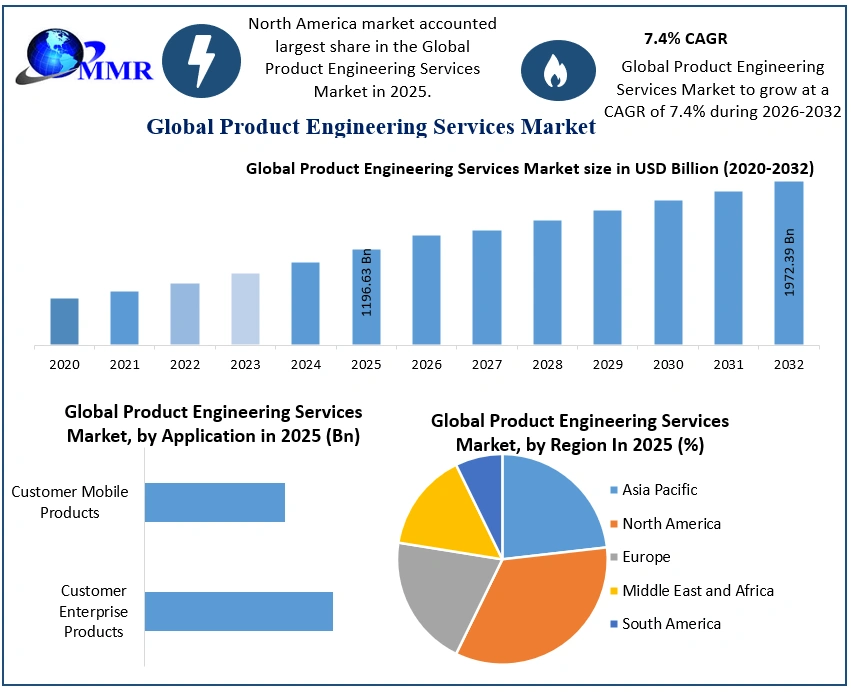
Product Engineering Services Market was valued at USD 1,196.63 billion in 2025 & is projected to reach USD 1,972.39 billion by 2032, growing at a CAGR of 7.4%.
Are your products truly intelligent? Maximize Market Research uncovers how the 2026 shift to Agentic AI engineering ensures your 7.4% R&D CAGR.”
ROCKVILLE , MD, UNITED STATES, March 20, 2026 /EINPresswire.com/ -- The global Product Engineering Services Market is entering a transformative era of "Software-Defined Everything," with its valuation projected to climb from USD 1,196.63 Billion in 2025 to a staggering USD 1,972.39 Billion by 2032. This trajectory, defined by a 7.4% CAGR, marks a fundamental shift from traditional hardware-centric development to intelligent, AI-native product architectures. As enterprises race to compress innovation cycles, the demand for cross-disciplinary engineering—merging embedded systems, cloud-native software, and advanced mechanical design—has become the primary driver for industrial growth.— Maximize Market Research
Get Full PDF Sample Copy of Report: (Including Full TOC, List of Tables & Figures, Chart) @ https://www.maximizemarketresearch.com/request-sample/122268/
According to Maximize Market Research, this evolution is underpinned by a massive surge in R&D outsourcing. By early 2026, over 60% of Fortune 500 manufacturers have pivoted toward "Co-Innovation" models, where service providers act as strategic partners managing the entire digital thread from ideation to deployment.
Product Engineering Services Market Dynamics: Navigating the Era of "Co-Innovation" and DevOps Complexity
The traditional "cost-arbitrage" model of outsourcing is rapidly evolving into a high-stakes Co-Innovation framework. As products become increasingly software-defined, the global Product Engineering Services Market is driven by the urgent need to integrate electrification, autonomous systems, and real-time connectivity. A definitive 2026 driver is the automotive industry's massive R&D shift; global automakers are currently investing over USD 270 Billion in digital development to decouple hardware from software.
However, growth is tempered by "DevOps Sprawl," where over 50% of engineering teams now manage six or more fragmented tools. This complexity creates interoperability bottlenecks that service providers must solve through automated, tool-agnostic environments. By harmonizing these workflows, enterprises can reduce R&D costs by up to 20%, transforming engineering from a localized task into a globalized, continuous innovation engine.
Key Trends: The Convergence of Digital Twin Fidelity and Generative Design
The innovation framework is undergoing a radical shift toward Digital Twin Fidelity. By early 2026, engineering teams are moving beyond basic 3D models to "Autonomous Twins" that simulate real-world physics in real-time. A definitive example is Airbus, which maintains high-fidelity digital twins of its A320neo and A350 families to virtually test design modifications, reportedly reducing physical testing requirements by up to 40%.
Simultaneously, the R&D outsourcing ecosystem is pivoting toward Generative Design. As seen in recent aerospace and automotive projects, AI-native tools are now producing lightweight, high-strength structural components that reduce weight by 30% to 50% compared to traditional methods. Furthermore, the co-design of specialized silicon and embedded software such as Tesla’s cloud-connected vehicle replicas ensures that products possess on-device intelligence. These technological anchors are essential for scaling toward the USD 1.9 Trillion milestone, redefining the boundaries of modern industrial production.
Product Engineering Services Market Segmentation: The Rise of Software-Defined Architectures
The structural landscape of this digital engineering ecosystem is undergoing a transition, with Software-Defined Architecture emerging as a dominant growth lever. Within the service-type analysis, the Product Development segment captured a significant revenue share in 2025, driven by the decoupling of hardware from complex software layers. Simultaneously, the Support and Maintenance category is exhibiting a high CAGR, as enterprises move toward "Continuous Engineering" models to facilitate over-the-air (OTA) updates and long-term digital-thread integrity.
From a vertical perspective, Automotive and Transportation remains the largest end-user, accounting for nearly 25% of market revenue in early 2026. This is followed by the Industrial Manufacturing and Healthcare sectors, where the integration of Industrial IoT (IIoT) and connected medical devices has transformed legacy portfolios into intelligent, data-driven platforms.
By Type of Services
Software engineering
Hardware engineering
Process engineering
Others
By Industry
BFSI
IT & Telecom
Automotive
Industrial manufacturing
Energy & Utilities
Healthcare
Aerospace & defense
Others
By Application
Customer Enterprise Products
Customer Mobile Products
By Organization size
Large Enterprises
SMEs
Get Full PDF Sample Copy of Report: (Including Full TOC, List of Tables & Figures, Chart) @ https://www.maximizemarketresearch.com/request-sample/122268/
Global Innovation Hubs: Strategic R&D Clusters and the Smart Factory Surge
The geographic distribution of this innovation framework is defined by a strategic split between high-value design centers and rapid industrial scaling. North America remains the dominant revenue contributor, holding a significant 41.1% share in early 2026. This leadership is sustained by the concentrated presence of tech giants in Silicon Valley and the Great Lakes automotive cluster. For instance, Ford and GM have recently pivoted toward "Software-First" engineering, driving massive local demand for embedded system integration and cloud-native vehicle architectures.
Conversely, the Asia-Pacific (APAC) region is the fastest-growing frontier, exhibiting a robust 8.4% CAGR through 2032. India and China have transitioned from back-office support to "Global Co-Innovation Hubs." A definitive example is India’s engineering ecosystem, which now manages end-to-end development for over 40% of global semiconductor firms, successfully shortening the global time-to-market for next-generation electronics
Strategic Orchestration: The Competitive Shift Toward "Platform-as-a-Service"
The competitive hierarchy within this R&D outsourcing ecosystem is being redefined by a wave of high-value mergers and the adoption of "Unified Engineering Platforms." A landmark shift occurred in late 2025 when Capgemini expanded its Intelligent Industry offerings, integrating 5G-edge capabilities with cloud-native product design to create a "Continuous Engineering" moat. This move allows for the seamless management of a product’s digital twin from initial silicon design through to end-of-life recycling.
Furthermore, leaders like HCLTech and TCS are pivoting toward Niche-Vertical IPs, particularly in the USD 1.9 Trillion automotive and med-tech spaces. By offering pre-built frameworks for autonomous driving and remote diagnostics, these dominant players are marginalizing smaller firms that lack the scale for deep R&D investment. This consolidation ensures that those controlling the most sophisticated Innovation-as-a-Service models capture the largest share of the 7.4% growth.
Product Engineering Services Market, Key Players
IBM Corporation
Capgemini
Altran
ALTEN Group
AVL
HCL
AKKA Technologies
Wipro
TCS
Accenture
Tech Mahindra
Infosys
Nexient
EPAM Systems, Inc,
Pactera Edge
Cognizant
Bitcomm Technologies
Segula Technologies
Assystem.
Get access to the full description of the report @ https://www.maximizemarketresearch.com/market-report/product-engineering-services-market/122268/
Strategic Evolution and M&A Activity in the 2026 Product Engineering Services Market
The innovation framework is being reshaped by high-value strategic consolidation. A landmark development occurred on March 10, 2026, with Capgemini’s acquisition of Piterion, significantly bolstering its global Product Lifecycle Management (PLM) and industrial digitalization capabilities. Simultaneously, on March 3, 2026, Accenture finalized an agreement to acquire Ookla, aiming to integrate real-time network intelligence into the 5G and Wi-Fi cores powering the digital engineering landscape.
Furthermore, technical leaders are prioritizing AI-native deployment. On February 20, 2026, HCLTech unveiled VisionX 2.0, a next-gen multi-modal AI Edge platform, while Wipro launched a new integrated operating model on January 29, 2026. These milestones highlight a shift toward "Self-Evolving Systems," where Over-the-Air (OTA) updates and autonomous diagnostics are becoming the standard for competitive market differentiation.
Navigating the USD 1.9 Trillion Frontier: A Product Engineering Services Market Analyst Perspective
From a strategic standpoint, Maximize Market Research analysts emphasize that the Product Engineering Services Market has moved beyond cost-reduction to a "First-Time-Right" engineering mandate. With the total revenue projected to reach USD 1,972.39 Billion by 2032, the focus has shifted toward high-fidelity digital infrastructure. Data indicates that integrating Agentic AI and Autonomous Twins can drive a 20% reduction in R&D costs, directly fueling the sector's 7.4% CAGR. This evolution from manual prototyping to data-reactive assets allows enterprises to capture innovation cycles with unparalleled precision, ensuring that every dollar spent in the development phase delivers measurable, scalable, and digital-first results.
FAQ’s
What is the primary growth driver for this ecosystem in 2026?
Ans: The transition to Software-Defined Everything (SDx) and the integration of Agentic AI are the core catalysts for the Product Engineering Services Market.
How does Digital Twin Fidelity impact R&D costs?
Ans: By moving from static models to "Autonomous Twins," enterprises are realizing a 20% reduction in prototyping expenses and accelerated time-to-market.
Which region leads in engineering innovation?
Ans: North America currently holds a 41.1% revenue share, while the Asia-Pacific region exhibits the fastest growth at an 8.4% CAGR.
What is the projected valuation by 2032?
Ans: Driven by a 7.4% CAGR, the total revenue is expected to reach USD 1,972.39 Billion by 2032.
Related Reports
IT Management as a Service Market: https://www.maximizemarketresearch.com/market-report/global-it-management-as-a-service-itmaas-market/98474/
IT Outsourcing Market: https://www.maximizemarketresearch.com/market-report/global-it-outsourcing-market/107568/
Engineering Services Outsourcing Market: https://www.maximizemarketresearch.com/market-report/global-engineering-services-outsourcing-market/20898/
Automotive Engineering Services Market: https://www.maximizemarketresearch.com/market-report/global-automotive-engineering-services-market/32395/
Network Engineering Services Market: https://www.maximizemarketresearch.com/market-report/network-engineering-services-market/186167/
Top Reports:
Flavors and Fragrances Market
Canned Soup Market
About Maximize Market Research
Maximize Market Research is a leading global market research and business consulting firm. Our revenue-impact and growth-driven initiatives empower Fortune 500 companies to navigate complex industrial shifts and secure high-value market dominance.
Domain Focus: Information Technology & Telecommunication
Our research evaluates the convergence of Software-Defined Everything (SDx) and Agentic AI frameworks. We analyze the lifecycle economics of hyperscale cloud-native architectures, from 5G-Advanced edge-computing to the Quantum-Ready infrastructure redefining global digital-thread integrity and throughput.
Lumawant Godage
MAXIMIZE MARKET RESEARCH PVT. LTD.
+ +91 96073 65656
email us here
Visit us on social media:
LinkedIn
Instagram
Facebook
X
Legal Disclaimer:
EIN Presswire provides this news content "as is" without warranty of any kind. We do not accept any responsibility or liability for the accuracy, content, images, videos, licenses, completeness, legality, or reliability of the information contained in this article. If you have any complaints or copyright issues related to this article, kindly contact the author above.
